Mental Health Awareness & Connection Month




Emotional Awareness & Regulation
Growing Together: Parent Support and Education Series
Parenting can bring moments of deep connection, joy and pride, and it can also bring moments that feel confusing, overwhelming or hard to know how to respond to. At Treat Yourself Well, Growing Together is our parent support series, grounded in connection, understanding and practical support.
Through a neurodiversity-affirming, inclusive, intersectional and trauma-informed lens, these programs are designed to support parents and carers to better understand children’s big feelings, strengthen connection, and develop practical strategies for everyday family life.
Emotional Awareness & Regulation
The first program in the Growing Together series is Emotional Awareness and Regulation, developed for parents and carers of children aged 5–12 years who are seeking developmentally sensitive, evidence-informed support, including nervous system understanding, to better understand emotions, respond to distress, set limits and boundaries, and support regulation across early and primary school years.
Families do not need to have a diagnosis or be currently engaged in therapy to enquire. If you are unsure which option may suit your family, our team can help you consider whether the group program or individualised package is more appropriate.


Choose How You’d Like to Take Part
Both options cover the same five-session program, the same pre-program planning call, and the same follow-up check-in call, the difference is simply how you receive it: as part of a group, or one-to-one.
Emotional Awareness & Regulation
Group Program
Our group program offers a practical and supportive 5-session series for parents and carers who would like to better understand their child’s emotions and develop practical strategies for responding to big feelings over time.
Across the series, parents will explore why children can have strong emotional reactions, how big feelings may show up in behaviour, and how to respond in ways that support both connection and boundaries.
-
A half-hour pre-program planning call with one of our psychologists
-
Five psychoeducational group sessions with one of our psychologists
-
A follow-up check-in call after the program
Fee: $750 per family. Payment options may be available.
Emotional Awareness & Regulation
Individualised Parent Support Package
Our individualised package provides more tailored support for families who would prefer one-to-one parent sessions with one of our psychologists.
Individual sessions allow the program to be shaped around your child, family context, parenting goals and current challenges. This may be helpful when families are navigating concerns such as ongoing distress, anxiety-driven avoidance, sibling conflict, school refusal, shutdowns, strong reactions to limits, screen-time struggles, homework stress, friendship difficulties, or transitions.
-
A half-hour pre-program planning call with one of our psychologists
-
Five individual parent sessions with one of our psychologists
-
Tailored examples and strategies related to your child and family context
-
A follow-up check-in call after the program
Fee: $1,450 per family
What the Sessions Cover
Understanding big feelings and behaviour
Responding to emotional storms
Building emotional awareness
Setting boundaries without battles
Supporting regulation skills over time
Who This May Support
This program may be helpful for parents and carers who would like to feel more prepared to respond to big emotions, distress, avoidance, frustration, sibling conflict, screen-time struggles, homework stress, friendship difficulties, school-related worries, or strong reactions to transitions and limits.
Understanding Big Feelings & Behaviour
1.
This session looks at why children have strong emotional reactions. We cover the basics of brain development in simple, parent-friendly terms, the difference between emotional overwhelm and intentional behaviour, and the role of co-regulation. We also explore how big feelings may look different in older children, such as worry, withdrawal, irritability, avoidance, perfectionism, or difficulty talking about what is happening.
The key takeaway from this session is understanding that behaviour is often a reflection of a child’s capacity, not defiance.
Responding to Emotional Storms
2.
This session focuses on what to do in the moment. Parents are guided through a clear, step-by-step response: stay calm, acknowledge the feeling, and set a limit if needed. We also look at common responses that can unintentionally escalate behaviour, and work through example phrases parents can use, such as “I can see you’re really upset. I’m here,” or “I won’t let you hit, but I can help you calm down.”
Parents leave this session with a practical, repeatable approach they can return to again and again.
Building Emotional Awareness
3.
This session is about teaching children about feelings. We explore how to help children name their emotions, expand their emotional vocabulary, and use everyday opportunities, like play, books, and routines, to build this skill over time.
The key takeaway is that emotional skills can be taught proactively, not just relied on during difficult moments.
Boundaries Without Battles
4.
This session focuses on setting limits calmly and consistently. We look at how to balance validation with clear boundaries, how to be firm without escalating a situation, and why consistency and follow-through matter so much. Example phrases covered include “I hear you don’t want to leave. It’s time to go,” and “You’re upset. The answer is still no.”
Parents leave this session able to feel both calm and confident when setting limits.
Supporting Regulation Skills Over Time
5.
The final session looks at helping children learn to calm themselves over time. We cover what emotional regulation is (and isn’t), age-appropriate calming strategies, and the role of routines, movement, and environment, including calm-down spaces, transition supports, and preparing for challenging situations in advance.
The key takeaway is that regulation is a skill that develops with support and practice, not something children either have or don’t.

How to Enquire
If you are interested in the Growing Together parent support series, or would like to explore whether Emotional Awareness and Regulation may be a helpful fit for your family, please contact Treat Yourself Well at info@treatyourselfwell.com.au or give us a call on (02) 9555 4810 to discuss the available options.
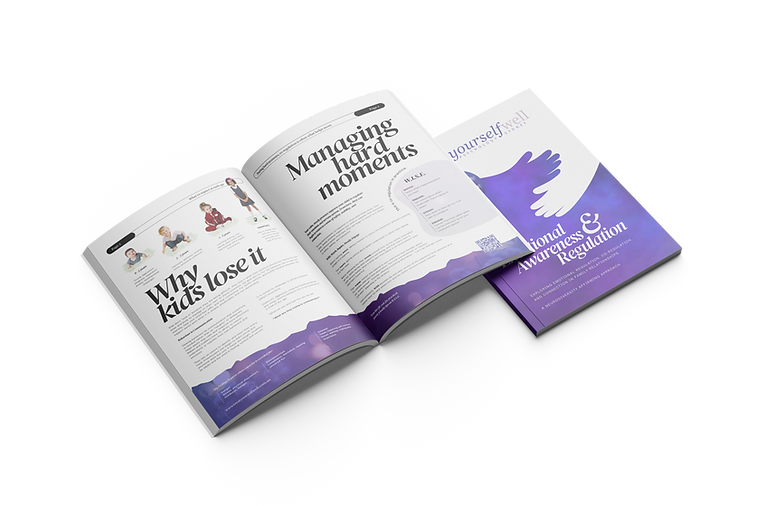
Free Emotional Regulation Booklet
A practical starting point for understanding and supporting your child’s big feelings.
Learning to recognise, understand, and gently respond to our thoughts and feelings is a key foundation for emotional wellbeing. When children develop emotional awareness, they begin to build the resilience and coping skills that support them across their lives.
Parenting often brings moments of joy, connection, and deep meaning, alongside times that can feel overwhelming, confusing, or harder than expected. We created this booklet to support you in understanding the important role emotions play in your child’s experiences, behaviour, and relationships.
It’s a starting point, offering practical, compassionate tools to help both you and your child build awareness and regulation skills, supporting greater calm, confidence, and connection over time.