


Intersectionality
"TYW believes that every individual deserves to be met with dignity, compassion, and curiosity."
At Treat Yourself Well, we recognise that every person is shaped by the interaction of many different experiences and identities. Factors such as culture, gender, neurotype, sexuality, disability, family background, relationships, socioeconomic circumstances, and life experiences all influence how people experience mental health and wellbeing.
An intersectional approach helps us understand the whole person rather than focusing solely on symptoms or diagnoses.
It encourages curiosity about the broader context of a person's life, including the strengths, challenges, systems, and environments that shape their experiences.
By working from an intersectional, trauma-informed, neuroaffirming, and relational lens, we aim to provide care that is inclusive, compassionate, and responsive to each person's unique story. We believe that meaningful support begins with understanding people in context and helping them feel genuinely seen, heard, and valued.
Why Intersectionality Matters
Traditional models of mental health often take a one-dimensional view, focusing on symptoms without considering the broader social and cultural context of a person’s life. However, identity is rarely experienced in isolation.
For example, a person who is neurodivergent, a member of the LGBTQIA+ community, and from a culturally diverse background may experience overlapping pressures, discrimination, or barriers to support. At the same time, they may also draw strength and resilience from their cultural traditions, community, or personal identity.
An intersectional lens acknowledges this complexity, helping us understand not only the challenges you face but also the unique sources of strength that shape your journey.

Mind, Body, Neurodivergence & Trauma
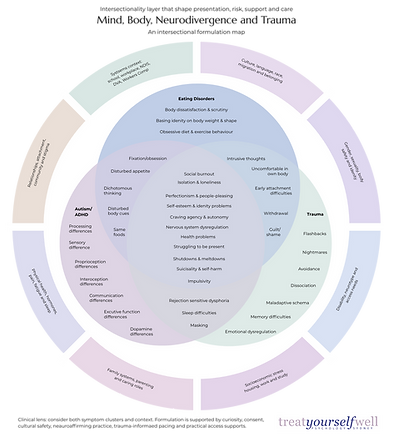
At Treat Yourself Well, our passion for intersectionality is closely connected to our specialist interests in eating disorders, trauma, and neurodivergence. We know that these experiences are deeply influenced by the many identities, systems, relationships, and environments that shape a person's life.
Eating disorders are not simply about food, weight, or appearance.
Trauma is not simply about past events.
Neurodivergence is not simply a diagnosis or label.
Each person's experience is influenced by culture, gender, sexuality, family systems, body image ideals, socioeconomic circumstances, discrimination, belonging, identity, access to support, and countless other factors.
An intersectional lens helps us understand these complexities with curiosity, compassion, and humility. It allows us to move beyond pathology and towards a deeper understanding of the whole person, ensuring that support and care feels relevant, affirming, collaborative, and meaningful.
Moving Beyond One Size Fits All
At Treat Yourself Well, we reject the idea that one approach can meet everyone’s needs. We know that mental health support must be tailored to the whole person—their history, community, identity, and lived experience.
Our therapists work with you to understand your story, respecting the ways in which your identity and circumstances intersect. This allows us to provide care that is not only personalised but also deeply respectful of your individual needs.
A Socially Just Approach to Psychology
By practising from an intersectional lens, we contribute to more equitable and socially just care. This means:
-
Recognising and challenging the impact of systemic barriers, such as racism, sexism, ableism, classism, and homophobia.
-
Valuing diverse voices and ensuring that lived experiences are centred in therapy.
-
Creating a safe, affirming, and culturally responsive space for all individuals.
Our goal is to ensure that therapy doesn’t just address mental health concerns in isolation but acknowledges the broader systems and structures that shape a person’s wellbeing.

Respect for Every Story
Every individual deserves to be met with dignity, compassion, and curiosity. Whether you are navigating eating disorder recovery, trauma, anxiety, relationships, neurodivergence, or other mental health concerns, we commit to meeting you exactly where you are—with a deep respect for your unique story and the context that has shaped it.
At Treat Yourself Well, your whole self and all your parts are welcome.


Intersectional Lens
Intersectionality - why this matters for us
Our intersectional model highlights the interweave of the human condition. We understand the impact of early attachment, trauma, underlying biology and our human need for connection. This is why we came up with this model where somethings fit in some areas and others may linger somewhere else and then there is a lot of other meta matter that hovers amongst it all. There are things that can't be fixed, nor do we need to fix as there are some fundamental neurological differences that make us who we are. What we can do though is understand the impact of our experiences and its intersectionality, learn about ourselves and then decide what actions we can, want and / or need to take to live the life we deserve to live... however, lets remember that it must all be in context! The below model is by no means an exhaustive list of experiences and differences! We have captured our experiences, and the experiences of others and what is in some of the literature...we also couldn't fit it all in to the circles :)
Why Intersectionality Matters in Mental Health
Traditional models of mental health often take a one-dimensional view, focusing on symptoms without considering the broader social and cultural context of a person’s life. However, identity is rarely experienced in isolation.
For example, a person who is neurodivergent, a member of the LGBTQIA+ community, and from a culturally diverse background may experience overlapping pressures, discrimination, or barriers to support. At the same time, they may also draw strength and resilience from their cultural traditions, community, or personal identity.
An intersectional lens acknowledges this complexity, helping us understand not only the challenges you face but also the unique sources of strength that shape your journey.
Moving Beyond “One Size Fits All”
At Treat Yourself Well, we reject the idea that one approach can meet everyone’s needs. We know that mental health support must be tailored to the whole person—their history, community, identity, and lived experience.
Our therapists work with you to understand your story, respecting the ways in which your identity and circumstances intersect. This allows us to provide care that is not only personalised but also deeply respectful of your individual needs.
A Socially Just Approach to Psychology
By practising from an intersectional lens, we contribute to more equitable and socially just care. This means:
· Recognising and challenging the impact of systemic barriers, such as racism, sexism, ableism, classism, and homophobia.
· Valuing diverse voices and ensuring that lived experiences are centred in therapy.
· Creating a safe, affirming, and culturally responsive space for all individuals.
Our goal is to ensure that therapy doesn’t just address mental health concerns in isolation but acknowledges the broader systems and structures that shape a person’s wellbeing.
Respect for Every Story
We believe that every individual deserves to be met with dignity, compassion, and curiosity. Whether you are navigating eating disorder recovery, trauma, anxiety, or other mental health concerns, we commit to meeting you exactly where you are—with a deep respect for your unique story and the context that has shaped it.
At Treat Yourself Well, your whole self is welcome.